← Back to course
Where AI Helps Research — and Where It Sabotages It
Research is one of AI's most tempting uses and one of its most dangerous, because the failure mode — a confident wrong answer — looks exactly like success. Let's get the map right before you rely on it.
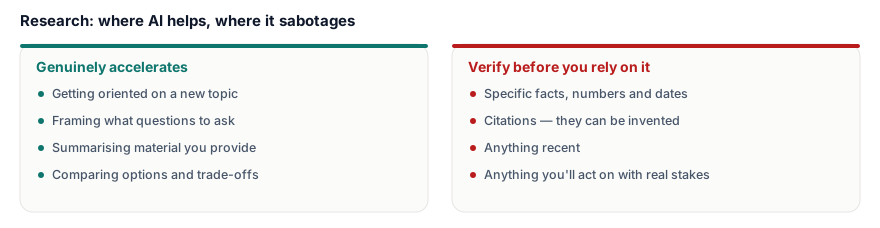
Where AI genuinely accelerates research:
- Getting oriented fast. "Explain [unfamiliar topic] like I'm smart but new to it." Perfect for going from zero to conversational.
- Framing your thinking. "What questions should I be asking about [decision]?" It's great at surfacing angles you missed.
- Summarizing material you provide. Paste a report, an article, a transcript — "what are the key points and what's the takeaway?"
- Comparing options. "Lay out the pros and cons of X vs. Y for a small business."
Where it sabotages you:
- Specific facts, numbers, dates, names. It will invent them fluently. Never take a figure or a citation from AI at face value.
- Recent events. Its knowledge has a cutoff, and it doesn't always know what it doesn't know about "now."
- Anything you'll act on with real stakes. Legal, medical, financial, regulatory — AI can orient you, but the real source makes the call.
The one rule that keeps research safe: use AI to understand and to point you at what to check — never as the final source of a fact. It's a brilliant briefing partner and a terrible encyclopedia.
▶️ Try this
Pick something you'd normally Google for 20 minutes. Ask AI to explain it and to list "what I should verify before relying on this." Notice that the second half — its own list of things to check — is often the most valuable part.